Add your promotional text...
Books on Language & Culture
Available on Amazon
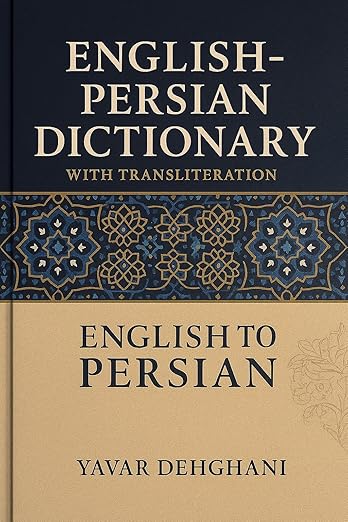
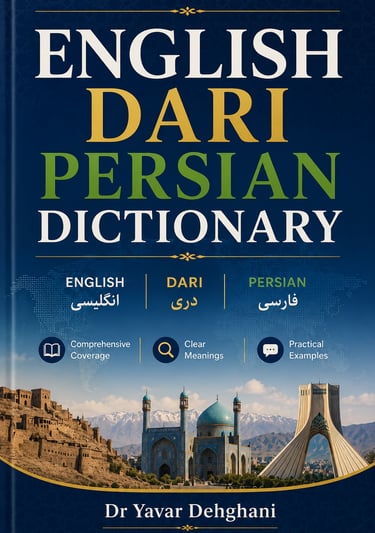
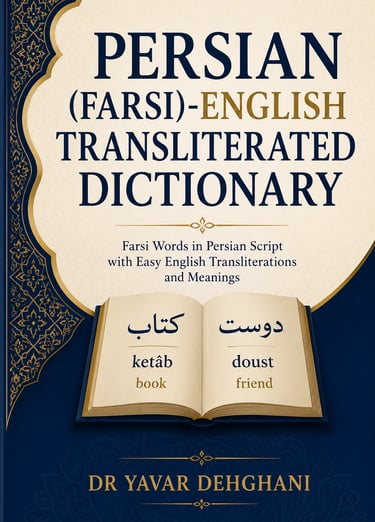
This dictionary has been thoughtfully designed for English speakers who are learning Persian, offering clear definitions, accurate translations, and helpful transliterations to support pronunciation. It serves a wide and diverse audience, including:
High school students in the United States, Europe, Australia, and other regions who are studying Persian as a second language.
English-speaking tourists traveling to Persian-speaking countries who wish to communicate more effectively and enrich their cultural experience.
University students enrolled in Persian language courses across academic institutions in the USA, Europe, and Australia.
Independent learners who are studying Persian for personal, professional, or cultural reasons.
Children of Persian-speaking migrant families living in Western countries who want to maintain their heritage language alongside English.
Native Persian speakers residing in English-speaking countries who are learning English and benefit from bilingual reference tools.
By combining English definitions with Persian equivalents and phonetic transliterations, this dictionary bridges the gap between languages and cultures, making Persian more accessible to learners at all levels.
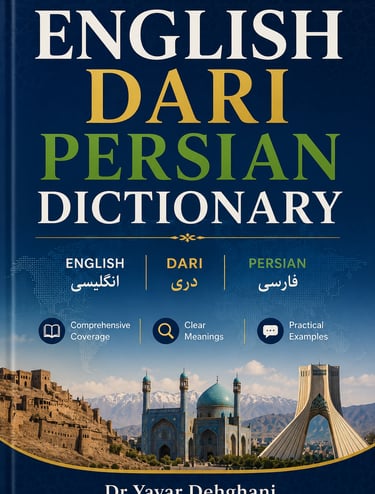
Persian and Dari are the same language — until they're not.
Both descended from Classical Persian, the language of Rumi, Hafez, and Ferdowsi. Both share the same script, the same grammar, and most of their vocabulary. Yet anyone who has worked across Iranian and Afghan communities knows that the differences matter — in translation, in communication, and in understanding.
English-Dari-Persian Dictionactical three-way reference that maps these differences side by side. For each entry, you get the Persian (Farsi) form used in Iran, the Dari form used in Afghanistan, and the English meaning — all in one place, at a glance.
This dictionary is for you if you are:
A translator or interpreter working across Persian and Dari
A humanitarian worker, aid professional, or NGO staff member operating in Afghanistan
A language learner studying either Farsi or Dari and wanting to understand both
A Persian speaker trying to communicate with Afghan Dari speakers, or vice versa
A researcher, journalist, or student working with Afghan or Iranian communities
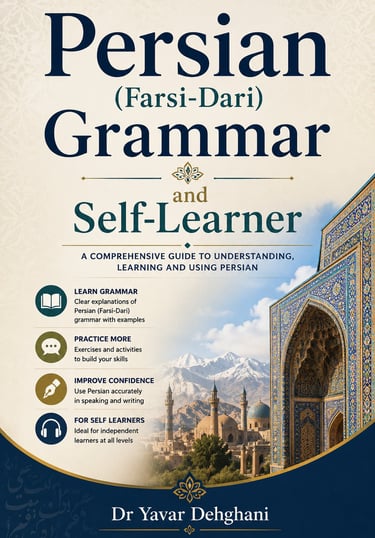
This Persian self-learning guide stands out for its innovative approach, rooted in comparative linguistics. Unlike traditional methods that focus solely on vocabulary and grammar drills, this book leverages the power of structural comparison between English and Persian. By highlighting the key differences and similarities in syntax, morphology, and phonetics, learners gain a deeper understanding of how Persian works in contrast to their native language.
The method is not theoretical—it has been refined through years of practical experience teaching Persian to adult English speakers in Australia. The author’s classroom-tested approach demonstrates that when learners grasp the underlying logic of both languages, they can overcome common hurdles more easily and achieve fluency faster. This book is designed for independent learners who value clarity, efficiency, and insight into the mechanics of language learning.
Whether you are a beginner or someone looking to strengthen your foundation, this resource offers structured lessons, comparative examples, and practical exercises that make Persian accessible and enjoyable. By understanding the “why” behind the language, you’ll not only learn Persian—you’ll learn how languages work.
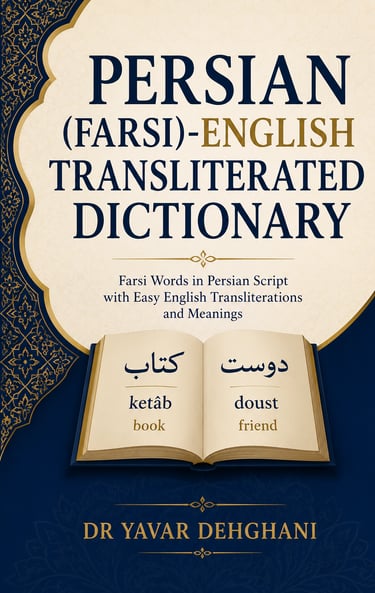
This dictionary uses transliteration as the basis for the word entries and makes it easier for the language learners who are not familiar with the Persian script or are not skilled enough in using it. In those few dictionaries which use transliterations, since the alphabetical order is based on Persian script, it is very difficult and in some cases impossible for a non-native speaker to find the word, especially for those who are at the first stages of learning the language. However, in this method, they would be able to find the transliteration as quick as the English word and they can match it with the equivalent word in the script. So, this dictionary is the first one which can be used by those who even do not know writing and reading in Persian script.
Persian (Farsi & Dari) belongs to the Indo-Iranian branch of the vast Indo-European language family, which includes many of the world’s major languages. It is one of the most historically rich and culturally significant languages in Asia, serving as a bridge between ancient civilizations and modern societies.
Persian is spoken primarily in Iran, where it is known as Farsi and serves as the official language of over 70 million people. It is also one of the two official languages of Afghanistan, where it is called Dari, and is widely used across government, education, and media. In Tajikistan, the same language is spoken in a slightly different form, known as Tajiki, written in the Cyrillic script. Beyond these countries, Persian-speaking communities can be found throughout the world — especially in the United States, Europe, and the Middle East — maintaining a strong connection to their linguistic and cultural heritage.
By learning Persian, you gain access not only to three closely related varieties of the language — Farsi, Dari, and Tajiki — but also to a shared cultural world that spans poetry, philosophy, history, and everyday life. While the Persian script may look complex at first glance, spoken Persian is surprisingly easy to learn, with simple grammar and a clear pronunciation system.
Most native Persian speakers do not speak English fluently, and any attempt by a foreigner to communicate in Persian is warmly welcomed. Even a few words spoken in their own language can open doors, spark smiles, and create immediate connections. Learning Persian is therefore not only a linguistic achievement but also a heartfelt invitation to engage with one of the world’s most hospitable and expressive cultures.
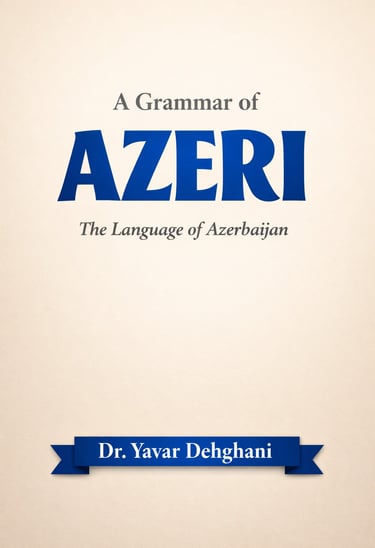
This book is derived from a doctoral thesis completed at the School of Linguistics, Faculty of Humanities and Social Sciences, La Trobe University, Melbourne, Australia, in May 1998. The original thesis explored a comparative analysis of the grammatical structures of Azeri, Turkish, English, and Persian, and a summary of this research was subsequently published as a book by Lincome Europa. Unlike the broader comparative work, the present volume focuses exclusively on the grammar of the Azeri language. It provides a detailed examination of Azeri grammatical structures while deliberately excluding phonological aspects. This book aims to serve as a specialized resource for linguists, language learners, and researchers interested in the structural features of Azeri, offering a comprehensive overview of its syntax, morphology, and grammatical patterns.
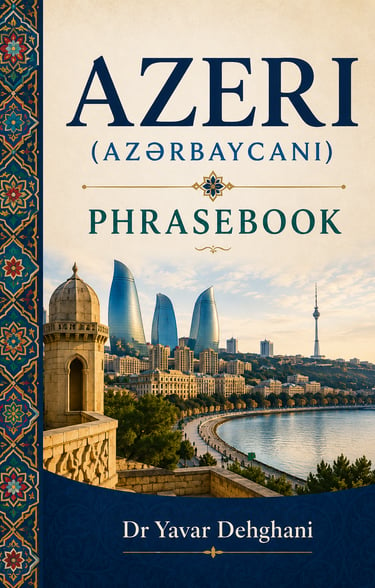
Azeri (Azerbaijani) Phrasebook
Learning Azeri has many benefits for foreign visitors. For example, by communicating in Azeri, they will be able to communicate effectively with the locals especially in remote areas where people are monolingual and do not know Persian very well. They can also find out about the culture and the history, and thus enjoy more visiting numerous monuments of the cities like Tabriz, Zanjan, Orumieh and Ardabil. By knowing Azeri, they will also be able to communicate with and understand the speakers of the related languages like Turkish. Although Azeri dialect of the Republic of Azerbaijan does not use many Persian words, and is influenced by Russian, you will still be able to communicate with them very well by using this phrasebook.
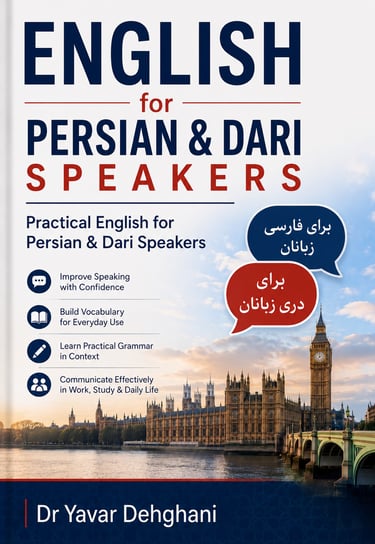
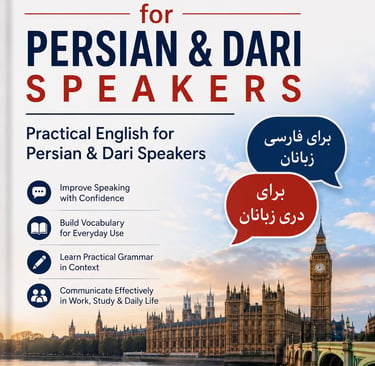
Practical English for Persian and Dari Speakers is a practical guide designed to help Persian and Dari speakers communicate confidently in everyday English.
This book focuses on the words, phrases, and simple conversations needed for daily life — including greetings, shopping, transportation, work, healthcare, and social interactions.
Written in clear and simple English, it is ideal for beginners, immigrants, refugees, and anyone who wants to improve their English for real-life situations.
Inside this book you will find:
• Essential English words and phrases
• Everyday conversations for daily situations
• Clear examples designed for Persian and Dari speakers
• Practical language you can use immediately
Whether you are starting a new life in an English-speaking country or simply improving your communication skills, this book will help you speak English with greater confidence.
A practical guide for real conversations in real life.
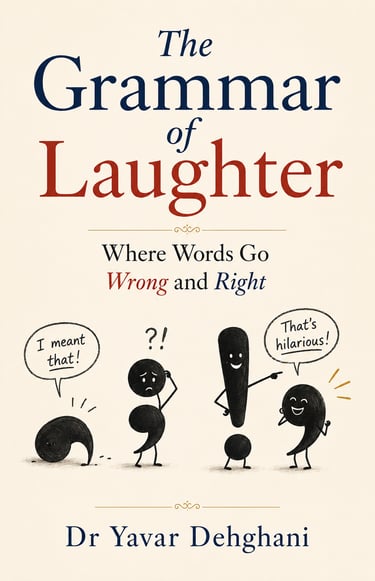
The Grammar of Laughter: Where Words Go Wrong and Right
Language is meant to make life easier—but often, it makes things hilariously complicated. The Grammar of Laughter takes you on a witty journey through the quirks, contradictions, and comic disasters of human communication.
From grammar slip-ups and punctuation jokes to mistranslations that spark comedy gold, this book explores why words fail, why we laugh, and why humor might be the best way to understand language.
Inside, you’ll discover:
✔ Why a single comma can save Grandma’s life
✔ The world’s funniest translation fails (and what they teach us)
✔ Puns, idioms, and wordplay from cultures around the globe
✔ How accents, slang, and autocorrect create accidental comedy
✔ The science behind laughter—and why it heals and connects us
✔ How humor evolved from ancient jokes to TikTok memes
Whether you’re a language lover, a teacher, a student, or just someone who enjoys a good laugh, this book will make you smile, groan, and see words in a whole new way.
Because when words go wrong, laughter gets it right.
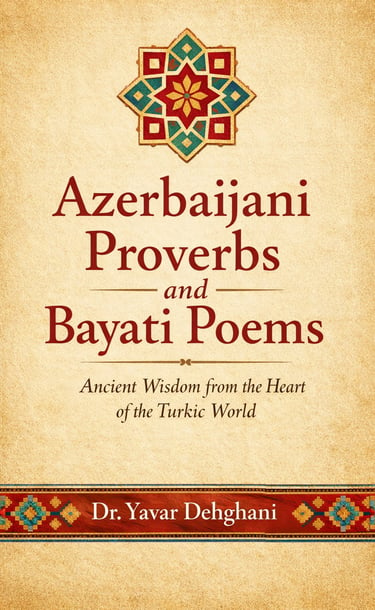
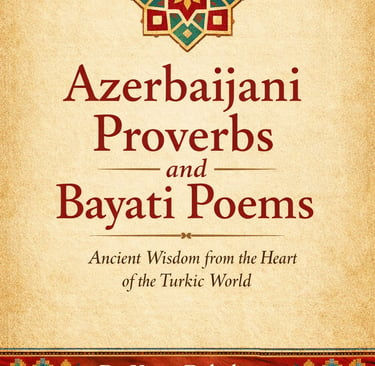
Azerbaijani Proverbs and Bayati Poems: Ancient Wisdom from the Heart of the Turkic World
For centuries, the Azerbaijani people have carried their deepest truths not in books, but in words — short, powerful sayings passed from generation to generation in markets, homes, and gathering places across the Caucasus and northwestern Iran.
This collection brings that living tradition to the world for the first time in accessible English translation.
Azerbaijani Proverbs and Bayati Poems gathers hundreds of traditional proverbs and bayatı — the beloved short poetic form unique to Azerbaijani culture — each presented in the original Azerbaijani script alongside its English translation. Together they offer a window into one of the world's most underrepresented yet extraordinarily rich linguistic and cultural traditions.
Inside this book you will find:
Hundreds of authentic Azerbaijani proverbs on wisdom, patience, friendship, family, hardship, and the human condition
Traditional bayatı poems — the distinctive four-line poetic form at the heart of Azerbaijani oral literature — in original and translation
Insights into the values, philosophy, and worldview of the Azerbaijani people across centuries
A rich introduction to the Azerbaijani language, its Turkic roots, and its unique place in world literature
Timeless sayings that speak directly to modern life — on resilience, love, loss, courage, and the search for meaning
Whether you are of Azerbaijani heritage seeking to reconnect with your roots, a student of Turkic languages and cultures, a lover of world poetry and proverbs, or simply someone drawn to the wisdom of ancient traditions — this book is for you.
These are not just words. They are the memory of a people. The heartbeat of a culture. The wisdom of generations.
Perfect for readers of world poetry, Turkic studies, cultural heritage, and collections of traditional wisdom.
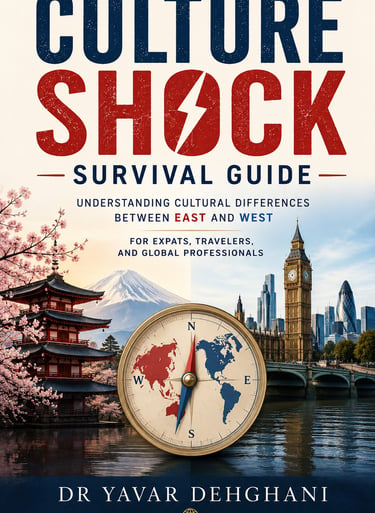
Why do misunderstandings happen — even when everyone means well?
Because culture is invisible. It shapes everything we do — how we greet strangers, raise children, handle conflict, show respect, give gifts, and draw the line between public and private. These invisible rules feel like common sense to the people who grew up with them. To everyone else, they can feel baffling, offensive, or simply strange.
That gap is culture shock. And this book closes it.
Culture Shock Survival Guide is a comprehensive A-to-Z cross-cultural glossary that explores the real differences between Eastern and Western values, behaviours, and social norms — not to judge them, but to understand them. Each entry examines a specific aspect of daily life from both perspectives, with real-world scenarios drawn from countries across Europe, North America, Iran, India, China, and beyond.
Each entry follows a clear, consistent format: how the East approaches it, how the West approaches it, real scenarios from specific countries, and a reflection that draws out the deeper values at play. No entry tells you which way is right. Both perspectives are treated with equal seriousness and respect.
Written by a linguist and educator who has lived between Eastern and Western cultures for decades, this book brings both scholarly depth and genuine human empathy to one of the most important challenges of our globalised world.
Culture shock is not a problem to solve. It is an opportunity to grow. This book shows you how.
Your mouth is capable of sounds you've never even tried to make.
Some languages get by with barely ten distinct sounds. Others use well over a hundred. Some languages have no word for "yes." Others force you to choose, every single time you say "we," between a version that includes the listener and one that quietly doesn't.
Language Is Weirder Than You Think collects 100 genuinely strange, true facts about how human language actually works, the sounds it makes, the grammar it builds, the scripts it's written in, what it does to your brain, and why it keeps dying and being reborn all over the world. Drawing on decades of work across Persian, Dari, Azerbaijani, Turkish, and English, linguist Dr Yavar Dehghani gathers the facts that make you stop mid-sentence and say, "wait, really?"
Inside, you'll find:
100 short, standalone facts, perfect for reading straight through or dipping into anywhere
Real examples drawn from Persian, Dari, Azerbaijani, Turkish, and English
Sound and pronunciation oddities, from click languages to whistled speech to sounds some languages have never needed at all
Grammar's stranger corners: languages with no grammatical gender, languages that mark how you know something, languages that build an entire sentence into one word
Writing systems invented on purpose by a single person, and scripts that still refuse to be deciphered
What a bilingual brain is quietly doing every time it moves between languages
Why languages die, and the deliberate, hopeful work of bringing them back
How Language Works: A Conversation Between a Human and an Alien
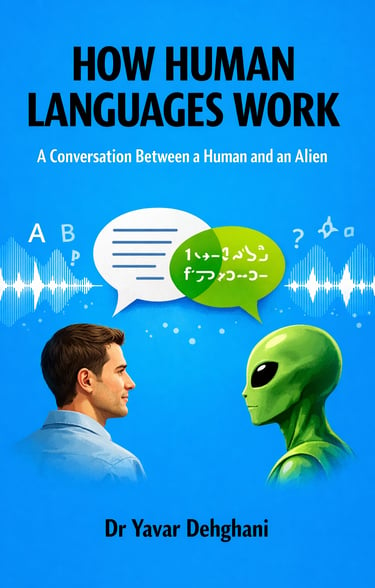
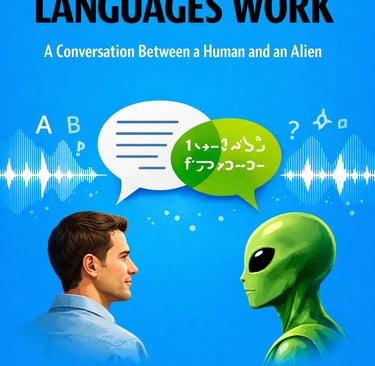
Why do some words disappear while others survive for centuries? Why is translation so much harder than it looks? How does a child learn to speak without a single grammar lesson? Why can the same sentence mean completely different things depending on who says it, to whom, and in what tone of voice? And why do humans — the only species on Earth capable of discussing abstract truth — use language so often to avoid it.
How Language Works explores these questions through a unique and surprising format: an A-to-Z glossary of human concepts, each examined as if by an intelligent outsider observing our species for the first time — with curiosity, occasional disbelief, and a persistent sense that something deeply revealing is hiding in plain sight.
This is not a conventional linguistics textbook. There are no diagrams, no technical jargon, and no dry academic definitions. Instead, each entry takes a familiar word or concept from human life — job, jealousy, justice, joke, jury — and examines it honestly. Not as we would like it to be, but as it actually is. The gap between those two things turns out to be one of the most interesting places in the world.
Written with wit, warmth, and genuine intellectual curiosity, this book sits at the crossroads of linguistics, philosophy, social observation, and comedy. It is accessible enough for a curious general reader and rich enough for anyone with a serious interest in how language shapes thought, culture, and human behaviour.


You studied English for years. You passed the test. You arrived. And suddenly you could not understand a word.
This is not a failure of intelligence. It is not a failure of effort. It is one of the most common and least understood experiences in the world — and it happens to millions of migrants, students, and language learners every day. The English of the classroom and the English of the street are different languages. And the silence that follows the discovery of that gap is one of the most damaging things a migrant can choose, even when it feels like the only safe option.
The Challenges of Speaking in a Second Language is the book that names what is happening, explains why it happens, and offers a clear, research-based path forward.
This book speaks to three audiences simultaneously. To migrants and language learners who have ever doubted their intelligence because they could not express it in another person's language. To English teachers, ESL educators, and language professionals who want to understand what their students are actually experiencing beneath the surface of their silence. And to supervisors, managers, and institutions working with people from linguistically and culturally diverse backgrounds who want to respond with understanding rather than assumption.
The gap between what a migrant knows and what they can currently express is not a measure of their capability. It is a measure of the difficulty of the task. And the task, with the right understanding and the right support, is one that every migrant can complete.


"My liver became fresh." "Don't eat my brain." "Go strain your yoghurt." "Eat your heart."
Millions of Persian speakers use these expressions every single day — and to them, they make complete sense. To everyone else, they sound absolutely hilarious.
Funny Persian Sayings and Expressions: Laugh While You Learn Persian is a delightful, entertaining, and genuinely educational guide to the most colourful, bizarre, and wonderful expressions in one of the world's oldest living languages. Each expression is explained in full, with Persian script, transliteration, literal translation, real meaning, cultural background, example dialogue, and the closest English equivalent.
WHAT IS INSIDE:
Food expressions — why yoghurt, soup, and liver say more than you think
Animal expressions — the donkeys, cats, and camels of Persian everyday speech
Body-part expressions — brains, livers, eyes, and hearts doing unexpected things
Family and relationship sayings — Persian wit at its most affectionate and sharp
Love and friendship expressions — warmth, loyalty, and playful teasing
Work and money sayings — Persian wisdom about life's practicalities
Cleverness and foolishness — the expressions Persians reach for when words fail
Luck and misfortune — how Persian speakers make light of life's difficulties
Everyday humorous expressions — the ones you will hear in every household
Azerbaijani compliments and words of praise
Playful insults and good-natured teasing
Expressions you should NEVER translate literally — and why
Persian is spoken by more than 110 million people worldwide and has one of the richest literary traditions in human history. Yet alongside the poetry of Rumi, Hafez, and Khayyam, Persian speakers have always had an equally rich tradition of humour, wordplay, and colourful everyday expression. This book celebrates that tradition.


Ever wondered why an Afghan grandmother might tell you "may your hands never hurt" instead of a simple thank you? Or why "the end of a dark night is bright" is one of the most comforting things a friend can say to you?
Funny Dari Sayings and Expressions is a warm, witty introduction to the idioms, blessings, and proverbs that make everyday Dari come alive. Forget dry vocabulary lists: this book takes you straight into real conversations, where a single phrase can carry centuries of hospitality, humor, and heart.
Across ten themed chapters, you'll explore:
Greetings and everyday courtesy
Family and home life
Tea, food, and hospitality
Friendship and love
Work, money, and success
Compliments and gratitude
Humorous expressions
Talking about feelings
Expressions you'll hear every single day
Classic Afghan proverbs
Each entry gives you the phrase in Dari script, its transliteration, a literal translation, its real conversational meaning, an example dialogue, and a cultural note explaining where it comes from and why it matters. Many chapters also include quick practice activities, so you can test what you've learned as you go.


"Don't hang noodles on my ears." "May I become the sacrifice for you." "Don't make pilav from it."
These are not mistranslations. These are perfectly normal things that Azerbaijani speakers say every single day.
Azerbaijani is a Turkic language spoken by millions of people across Azerbaijan, north-western Iran, Russia, Georgia, and Azerbaijani communities worldwide. It is a language shaped by centuries of history, hospitality, poetry, and humour — and like every living language, it has expressions that make complete sense to native speakers and sound wonderfully bizarre to everyone else.
Funny Azerbaijani Sayings and Expressions: Laugh While You Learn Azerbaijani takes you inside that tradition. Each expression is presented with the Azerbaijani original, pronunciation guide, literal translation, real meaning, cultural explanation, example dialogue, and the closest English equivalent — so you don't just learn what Azerbaijani speakers say, you understand why they say it.
WHAT IS INSIDE:
Food expressions — bread, tea, pilav, and salt doing more than feeding people
Animal expressions — the colourful creatures of Azerbaijani everyday speech
Body-part expressions — ears, eyes, and hearts saying the unexpected
Family and relationship sayings — Azerbaijani warmth and wit in equal measure
Love and friendship expressions — affection expressed in surprising ways
Work and money sayings — practical wisdom with a humorous edge
Cleverness and foolishness — the expressions Azerbaijanis reach for when words fail
Luck and misfortune — making light of life's difficulties
Everyday humorous expressions — the ones you will hear in every household
Azerbaijani compliments and words of praise
Playful insults and good-natured teasing
Expressions you should NEVER translate literally — and why


Some feelings only exist because a language decided to name them.
Persian has a word for the specific ache of missing someone (del-tang, literally "heart-tight"). A word for the intense, almost hyperbolic love that makes you want to sacrifice everything for someone (eshgh). A word for the quiet, dignified endurance that gets you through hardship without complaint (sabr). English has no single word for any of these. This book is about the 32 words it should.
Each chapter is a deep dive into one Persian word: its script, its literal meaning, its etymology, and the emotional or cultural territory it covers that English vocabulary simply doesn't reach. Some of these words are warm (naz, the coy, cherished reluctance of someone who knows they're adored). Some are heavy (ghorbat, the specific ache of being a stranger far from home). Some are genuinely contested even among Persian speakers themselves (gheyrat, examined honestly from more than one side). All of them tell you something real about how Persian speakers actually feel, live, and relate to one another.
Inside, you'll find:
32 untranslatable Persian words, each shown in Persian script, transliteration, and literal gloss
The word's etymology, often tracing back through Arabic, Sufi poetry, or pre-Islamic Persian tradition
How the word is actually used in everyday speech, with real phrases and expressions
Honest, evenhanded treatment of the culturally complicated words, not just the pretty ones
A closing arc that moves from del (heart) all the way to delkhosh (a heart at peace)
Languages
Expert in linguistics and translation services.
yadehghani@gmail.com
© 2025. All rights reserved.